

The Gallantry
Design Journal
Entry #1
The Gallantry
Design Journal
Entry #1
Map making is not such a hard thing to do, I believe. The hard part is in the design of the maps. StarEdit is a relatively easy program to use, and packs a lot of power for mapmakers. However, no matter how good the map editor is, if the idea behind the map is bad, the final result will suck. The Gallantry is aiming at perfection, and a good part of the success will go in the quality of the maps.
The first thing I did when I started to work on Episode 1-1 was to read the official script. From it, I learned what tileset I should use, what was the plot of the episode and what heroes were involved. I also figured the mood of the map – in the case of 1-1, a dramatic situation for a band of Protoss on Aiur.
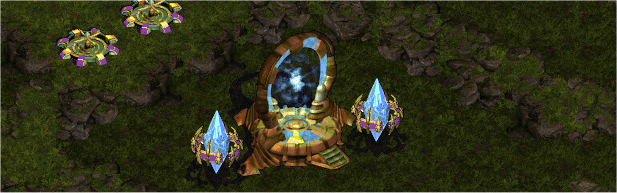
Magic worked on the terrain of 1-1. He designed a nice two-sided jungle map with a lot of mountains. On one side, he built a Protoss fortress, and on the other a Zerg base.
The hard part of map design now comes in. Although the script tells the general objectives of the map, and whatever plot sequences will happen, it gives us to clue at the actual gameplay. It is our job to figure out how the player will actually play the map, while integrating the plot with whatever task we will launch the player on. For 1-1, the obvious choice was to survive Zerg attacks over a certain period of time. But I thought that was a bit too classical, so I added the no-pylon restriction, giving a new meaning to the word “defend the base”. I also gave the player a chance at destroying the Zerg base, while making sure he won’t be able to succeed.
When the actually gameplay has been decided, the only task left is to code the triggers and the briefing of the map. As the map gets worked on, we generally do not add any sound or music to it so that it can be transferred more quickly for reviewing. So, I use a general empty wav file to create the transmission triggers, using a stopwatch to estimate the transmission time. The most important aspect of coding the map is quality. Things like using a transmission triggers instead of just playing a wav file and displaying some text, the use of color text when appropriate and the formatting of the transmission’s text according to Blizzard’s standards. This is, what I think, will make the difference between a good map and a fantastic map.
When the map is fully coded and reviewed, all the sounds and music files are added, the triggers are upgraded, and finally the map undergoes a final testing phase before it is released to the public.
-BahamutZERO
Mapmaking is usually a casual and pleasurable experience. For The Gallantry maps, yes- of course it has been, yet add two words to the mixture: 'deadline' and 'pressure'. Xavier set a fair deadline, I don't deny that, but when real life burdens got in the way, I really had to set something’s aside and get to work. And when you’re making maps for a campaign series of which the expectations are great (Making quality close to Desler’s standards)- there’s a fair bit of pressure. However, both myself and BahamutZero got to work. From the script, I planned out the vague, general gameplay and soon gave some of the maps to Bahamut to do to meet said deadline. It’s been tough, but it’s certainly been fun and a new way of working.
- Magic
[an error occurred while processing this directive]